• As the most expensive gubernatorial race in Ohio history nears its end, Republican candidate and billionaire Vivek Ramaswamy is deservedly facing bipartisan pushback for a controversial $4 million attack ad campaign featuring the estranged mother of his Democratic opponent, Amy Acton.
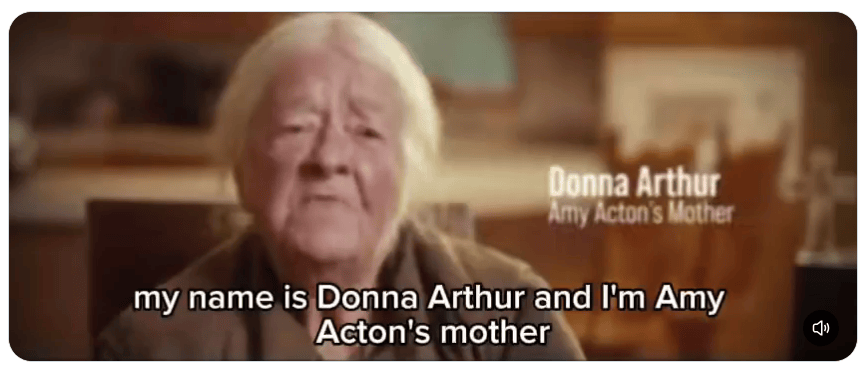
    Screenshot sourced from Twitter

    “Amy has a serious problem, she is a liar, she lies about her past,” Donna Arthur says directly to the camera. “She’s lied her entire life. My daughter needs help. And she can’t help you if she needs help herself.”

    It’s a middling message that places all of its punch on the shoulders of the messenger; after all, who knows someone better than their own mother? The catch is that family dynamics are never simple, and, in this specific case, the factual record establishes that they were allegedly criminal.

    Following the ad’s circulation on social media, Acton and her brother provided a trove of legal documents and previous local media coverage confirming that they were removed from their mother’s care in 1978 after Acton—then 12—was raped by her stepfather, to whom her mother remained married until his death in 2004.
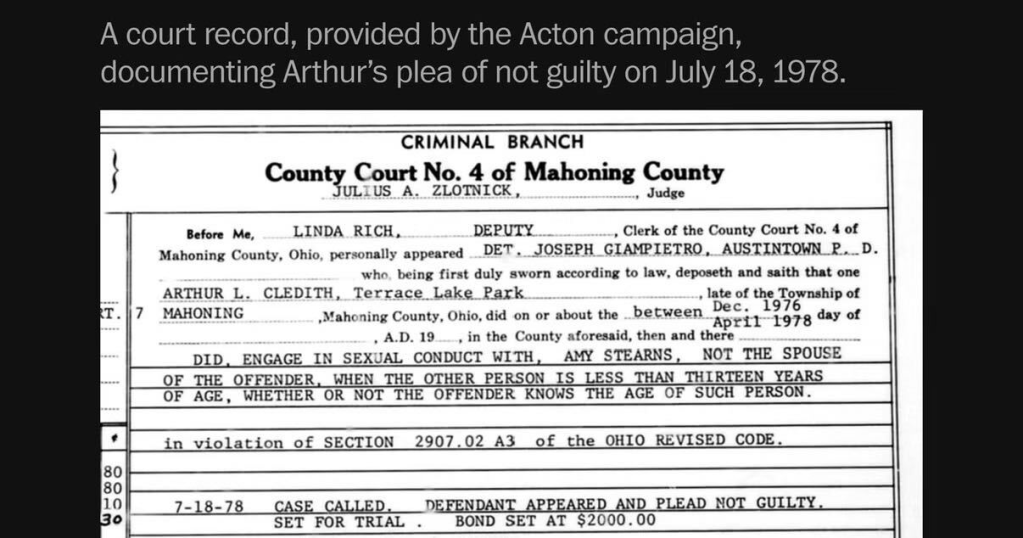
    Screenshot sourced from The Washington Post Instagram account

    The still-unfolding controversy serves as an especially traumatic example of what may be the singular universal truth when it comes to both family and politics: The messenger is as important—if not more important—than the message itself.

    Ramaswamy has now doubled down on his campaign’s ad, and we may never know how—or whether—Ramaswamy’s campaign vetted Arthur before putting her in front of their camera. But a competent researcher reviewing Acton’s previous press coverage should have found the 2019 column in her hometown newspaper recounting her stepfather’s alleged sexual abuse, the resulting criminal charges, and her estrangement from her mother. Those were leads to investigate: pull the court records, establish the chronology, and examine Arthur’s role before presenting her as an authority on her daughter’s character.
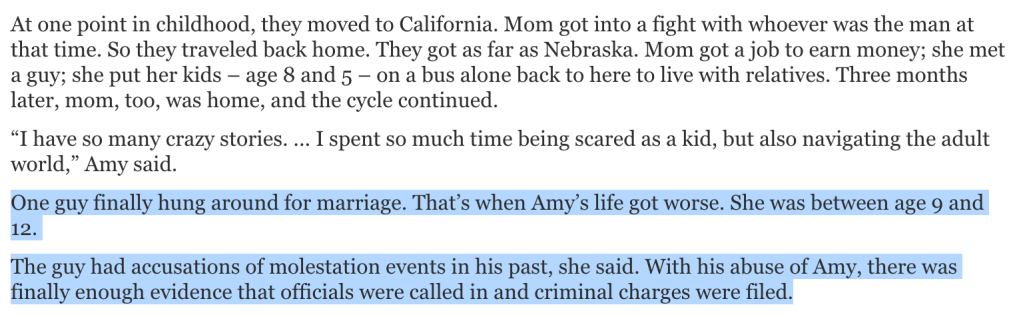
    Screenshot sourced from The Vindactor

    Following that trail should have produced a clear recommendation against this ad. The relationship that made Arthur seem like a compelling messenger became, upon examination, the very reason not to use her.
  • Defensive Research: The Ultimate Self-Portrait

    When people seek competitive intelligence, especially in a corporate or political campaign setting, they are often looking to find ways to effectively draw contrast between their adversary and themselves. As such, defensive research (opposition research methods deployed on yourself or allies) completes the total picture for the most effective strategy.

    While it may sound counterintuitive to research yourself, the following scenarios are not uncommon:

    1. Life and memories are long: People and businesses can (understandably) forget about potential vulnerabilities as they age and grow. What may not have been a potential vulnerability at the time may be controversial under different circumstances or culture.
    2. Perception is reality: We know the full context of our lives and decisions, but the public never will. Opponents are often able to weaponize information that may seem innocuous from lived experience but hit different (and still factually accurate) when edited and sensationalized.
    3. Better safe than sorry: People or businesses are often unaware of just how much information is publicly available, even years after the fact. Defensive research allows you to definitively know what others are able to find—and potentially weaponize.
  • What Is (And Isn’t) Competitive Intelligence/Opposition Research?

    Overview

    In the United States, every person (yes, even you!) accumulates publicly available records that document aspects of their lives. Voter registrations, legal and property records, and business filings are just a few examples of information accessible not only to researchers, but also to journalists, public advocates, and—well—anyone!

    When an individual or organization rises to a place of public prominence—electorally, in business, or otherwise—interest in those documents increases accordingly. Importantly, ethical targets of competitive intelligence/opposition research do NOT include random private citizens or other persons. Projects focus on businesses and public officials and figures, as well as the individuals or groups who directly influence them.


    Our approach

    Drawing from a journalism-centered background, Keystone Intelligence first and foremost believes in the public’s right to know who is influencing the decisions that impact our communities and institutions.

    While laypeople may perceive competitive intelligence/opposition research as simply “digging for dirt,” the reality is much more nuanced. At its best, this work is a strategic instrument of accountability—an arrow in the quiver of informed democracy and business excellence. By gathering and contextualizing actionable information, Keystone Intelligence helps ensure that key stakeholders can make decisions rooted in truth.


    Same definition, different contexts

    “Competitive intelligence” refers to the collection and analysis of publicly available information to uncover relevant, fact-based patterns and narratives. This term is most commonly used within business contexts. Companies conduct this type of research for a variety of due-diligence purposes, many of which are never made public. Alternatively, such research can be used to inform investor campaigns or public-pressure initiatives against a competitor.

    “Opposition research” shares similar methods to competitive intelligence but typically serves political or advocacy clientele. Findings can be used for anything from closed-door campaign strategy or releasing damaging information to the public through press outreach, digital content, or other communication channels.


    Competitive intelligence is NOT private investigation

    Many people confuse competitive intelligence/opposition research with private investigatory services. Keystone Intelligence is NOT licensed to perform these services and therefore, as a matter of law, does NOT engage in private surveillance activity.

    Some of the key differences between private investigation and competitive intelligence/opposition research are as follows:

    1. Purpose and Context: Competitive intelligence/opposition research is used to inform business, electoral, and other public decisions rather than settle interpersonal conflict. While opposition researchers in particular sometimes engage in what is known as tracking—recording a target’s public appearance for later use—some private investigatory methods such as staking out private residences or combing through a target’s garbage are not typically considered ethical.
    2. Sourcing and Transparency: Competitive intelligence/opposition research is often intended for use in public settings where citations and sourcing are subject to external scrutiny. Private investigators may produce accurate findings, but those findings often lack verifiable or citable origin and are therefore unusable in many public-facing contexts.
    3. Strategy-First: Private investigators are often focused on obtaining specific evidence of a particular act rather than compiling and analyzing a critical mass of public information for use in private or public strategy.